How the Remote Monitoring Application Works
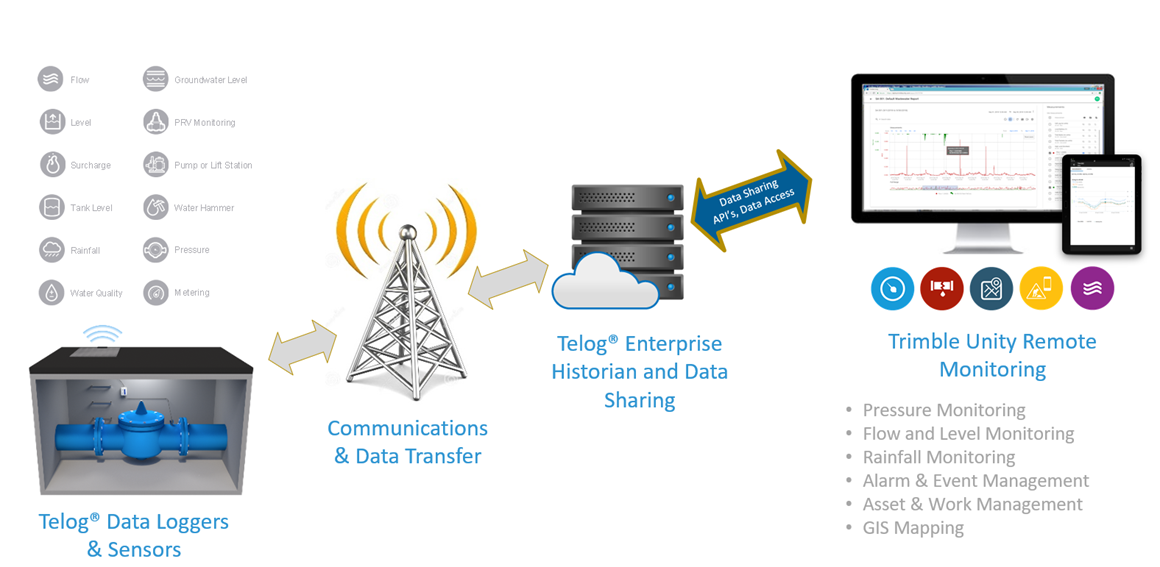
The Remote Monitoring solution can be separated into three separate conceptual components.
- In the field, at a monitoring site, there are Recording Telemetry Units (RTUs) connected to a variety of sensors that measure specific characteristics of the environment depending on the network (water, sewer, stormwater etc.). Example measurements may include water pressure, flow, depth, water quality characteristics, rainfall etc. RTUs capture and store this data locally based on certain configuration parameters including the sample rate and recording interval. RTUs also support generation of alarms based on series of high and low thresholds you can configure for each site/RTU. You can also configure the frequency with which the RTU sends this recorded data back from the site (or ‘calls in’) to the center, where it is permanently stored and subject to analysis. (see Remote Monitoring Software, below)
- Communication infrastructure. The overall remote monitoring solution relies on communication infrastructure to get the data from the field back to the center (by center we are talking about a centralized software and database hosted either on the cloud or in some circumstances at a client site). Depending on the location of the RTU (its site) and the capability of the RTU there may be a variety of options for communication of the data. Most frequently the solution will exploit 4G LTE cellular networks to send the data back via an onboard modem. However in some cases where a monitoring site has access to a utilities fixed network (for example, ethernet at a pumping station), it makes sense to use the fixed network as the communication method when the RTU supports this method of communication.
- Remote Monitoring cloud-based and mobile software. The final piece of the jigsaw is the Remote Monitoring software (including the ‘Historian’ database). As the RTUs call into the Remote Monitoring software, the data is stored in a ‘historian’ database optimized to manage large amounts of data in a time series format. The web-based Remote Monitoring client is the principal means by which users view and manipulate the data from each of the RTUs. The Remote Monitoring users can view the measurements sent in from the RTUs in time series reports and you can also use it to configure the RTU channels, alarms, and sampling and recording parameters. The Remote Monitoring web app also provides a dashboard that summarizes key events and alarms on the network as well as monitoring some key system health parameters such as battery life. The corresponding Remote Monitoring mobile apps allow you to view measurements graphs in the field, and to manage the installation of RTUs at sites in the field.